You cannot have a Pagan Tau or Tammuz Symbol on nor in your Church, just as:
You cannot have a SWASTIKA,
ON YOUR CHURCH/MEETING HALL:
Whether you believe in a SWASTIKA or not.
YOU MUST remove it.
Jesus WAS put to death on a one piece one direction upright pole= I (rendered "tree") 1 Peter 2:24
With his hands/wrists nailed through
above his head
NOT
2 or more PAGAN SYMBOL pieces forming Pagan Tau Cross shapes.
NOT t or T = NOT Tau shapes

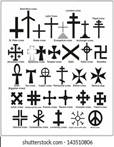
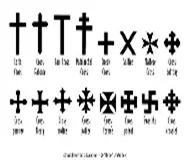
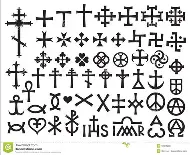
Do NOT have a PAGANIZED form of Christianity
Jesus WAS put to death on an upright pole rendered "tree" in 1 Peter 2:24 from the Greek word stauros, which means an upright stake.
A study of history shows that the cross symbol predates Christianity. According to author Ralph Woodrow,
"Centuries before the Christian era, the cross was honored as a religious symbol by the people of Babylon.
It is seen on their oldest monuments. Historians state that it was a symbol associated with Tammuz (Babylonian Mystery Religion, p. 51).
From Babylon, the cross spread to other nations and was associated with paganism long before Jesus' crucifixion in A.D. 31.
Woodrow further explains, "It was not until Christianity began to be PAGANIZED that the cross came
to be thought of as a Christian symbol.
It was in 431 A.D. that crosses in churches and chambers were introduced, while the use of crosses on steeples did not come until about 586 A.D." (p. 50).
While most people today connect the cross with Christianity rather than paganism,
we cannot think that a cross/firing squad rifle/electric chair
is something to be worshiped or honored.
While the apostles preached “stauros"= POLE not cross, “the POLE” as part of the history of Christ's ministry for our sakes (1 Corinthians 1:17–18), it was not something they idolized.
It was a shameful instrument of death. Hebrews 12:2.
In His crucifixion, Jesus took on Himself our shameful sins. Having our sins forgiven is a wonderful blessing, but there is no need to glorify the instrument noose, rifle, electric chair used.
Finally, consider what the Bible teaches about wearing any religious symbol. Under the Old Covenant that God made with ancient Israel, God instructed them to wear reminders of their faith upon their hands (Deuteronomy 6:8; Deuteronomy 11:18). In fulfillment of this command, phylacteries, small leather boxes containing scriptural passages, were traditionally worn by Jewish men during their morning weekday prayers. Many did this to appear righteous to others (Matthew 23:5).
During His New Testament ministry, Jesus taught His followers to display their spirituality through their actions and deeds (Matthew 5:16). Under the New Covenant, ushered in by Christ, God's laws are to be written on our hearts—that is, in our minds (Hebrews 8:10; Hebrews 10:16). People who truly practice the Christianity of the Bible stand out as beacons of light in a spiritually darkened society because of the way they live. They have no need to have external signs like a cross to identify themselves as Christians.
There was NO “CROSS” involved in the crucifixion:
There even was NO surplus WOOD available to even use a “cross” beam. All the forests had been cut down decades prior creating a shortage of timber.
It was an upright STAKE dug into the ground and raised up on a STAKE, with hands/wrists nailed above the head.
Ecclesia/CHURCHES using a Pagan Cross that existed before Christ, in their worship service is a SIN.
God’s Bible COMMANDS: Not to have images of “ANYTHING”. The Second Commandment:
“You shall not make for yourself a carved image—any likeness of anything
that is in heaven above, or that is in the earth beneath, or that is in the water under the earth; Exodus 20:4-6
Take that "cross" symbol off of the Lectern. BECAUSE it was a stake= I and not a PAGAN t cross:
Why True Christians
Do Not Use the Cross in Worship
The cross is, in fact, PAGAN in origin. The New Catholic Encyclopedia admits:
“The cross is found in both pre-Christian and non-Christian cultures.”
Various other authorities have linked the cross with nature worship and pagan sex rites.
THE cross is loved and respected by millions of people. The Encyclopedia Britannica calls the cross “the principal symbol of the Christian religion.” Nevertheless, true Christians do not use the cross in worship. Why not?
An important reason is that Jesus Christ did not die on a cross. The Greek word generally translated “cross” is stau·rosʹ. It basically means “an upright pale or stake.” The Companion Bible points out: “[Stau·rosʹ] never means two pieces of timber placed across one another at any angle . . . There is nothing in the Greek of the [New Testament] even to imply two pieces of timber.”
In several texts, Bible writers use another word for the instrument of Jesus’ death. It is the Greek word xyʹlon. (Acts 5:30; 10:39; 13:29; Galatians 3:13; 1 Peter 2:24) This word simply means “timber” or “a stick, club, or tree.”
Explaining why a simple stake was often used for executions, the book Das Kreuz und die Kreuzigung (The Cross and the Crucifixion), by Hermann Fulda, states: “Trees were not everywhere available at the places chosen for public execution. So a simple beam was sunk into the ground. On this the outlaws, with hands raised upward and often also with their feet, were bound or nailed.”
The most convincing proof of all, however, comes from God’s Word. The apostle Paul says: “Christ purchased us, releasing us from the curse of the Law by becoming a curse instead of us, because it is written: ‘Accursed is every man hung upon a stake [“a tree,” King James Version].’” (Galatians 3:13):
King James
Bible
Christ hath redeemed us from the curse of the
law, being made a curse for us: for it is written, Cursed is every
one that hangeth on a tree:
New King James
Version
Christ has redeemed us from the curse of the law,
having become a curse for us (for it is written, “Cursed is everyone
who hangs on a tree” ),
King James
2000 Bible
Christ has redeemed us from the curse of the
law, being made a curse for us: for it is written, Cursed is every one that
hangs on a tree:
New Heart
English Bible
Christ redeemed us from the curse of the law, having
become a curse for us. For it is written, "Cursed is everyone who hangs on
a tree,"
World English
Bible
Christ redeemed us from the curse of the law,
having become a curse for us. For it is written, "Cursed is everyone who
hangs on a tree,"
American King
James Version
Christ has redeemed us from the curse of the law,
being made a curse for us: for it is written, Cursed is every one that hangs on
a tree:
American
Standard Version
Christ redeemed us from the curse of the law,
having become a curse for us; for it is written, Cursed is every one that
hangeth on a tree:
A Faithful
Version
Christ has redeemed us from the curse of the law,
having become a curse for us (for it is written, "Cursed is everyone who
hangs on a tree")
Darby Bible
Translation
Christ has redeemed us out of the curse of the
law, having become a curse for us, (for it is written, Cursed [is] every one
hanged upon a tree,)
English
Revised Version
Christ redeemed us from the curse of the law, having
become a curse for us: for it is written, Cursed is every one that hangeth on a tree:
Webster's
Bible Translation
Christ hath redeemed us from the curse of the
law, being made a curse for us: for it is written, Accursed is every one that
hangeth on a tree:
Here Paul quotes Deuteronomy 21:22, 23, which clearly refers to a stake, not a cross.
Since such a means of execution made the person a curse”,”
it would not be proper for Christians to decorate their homes with images of Christ on a “cross”.
.AND FURTHERMORE:
There is no evidence that for the first 300 years after Christ’s death, those claiming to be Christians used a cross in worship.
In the fourth century, however, pagan Emperor Constantine became a convert to apostate Christianity and promoted the cross as its symbol. Whatever Constantine’s motives, the cross had nothing to do with Jesus Christ. The cross is, in fact, pagan in origin. The New Catholic Encyclopedia admits: “The cross is found in both pre-Christian and non-Christian cultures.” Various other authorities have linked the cross with nature worship and pagan sex rites.
Why, then, was this pagan symbol promoted? Apparently, to make it easier for pagans to accept “Christianity.” Nevertheless,
Devotion to any pagan symbol Tau
is clearly condemned by the Bible.
16.…What agreement is there between the temple of God and idols?... 2 Corinthians 6:14-18.
The Scriptures also forbid all forms of symbol idols Ex 20:4, 5; 1 Corinthians 10:14 with very good reason,
therefore true Christians
do not use a cross/noose in worship.